
If you’ve been down a sleepless rabbit hole lately, you’ve probably come across CBN. It’s showing up everywhere, and the claims are hard to ignore. But for every brand making bold promises, a woman is wondering what CBN is and whether any of it is backed by real science. You deserve a straight answer, not a marketing pitch.
Here’s the honest version: the clinical research on CBN for sleep is still developing, but the mechanism is plausible, the anecdotal evidence is strong, and scientific interest is accelerating fast. For women navigating hormonal sleep disruption—the 3 AM wake-ups, the night sweats, the thoughts that won’t quit—it’s one of the more promising areas of cannabinoid research right now.
Here’s what we know.
What Is CBN?
CBN—cannabinol—is a minor cannabinoid found in the cannabis plant. Unlike CBD, which grows abundantly in hemp, CBN forms through a specific process: as THC ages and oxidizes, it converts into CBN. Oxygen and light drive that conversion over time, which is why older cannabis has historically produced more sedative effects. The oxidation process strips away the psychoactive potency—but leaves some of the calming qualities intact. That’s where the sleep conversation begins.
Like CBD, CBN is non-psychoactive—it won’t get you high. But the two cannabinoids work differently in the body. CBD interacts broadly across the endocannabinoid system, engaging a wide range of receptors throughout the body. CBN works more selectively, targeting CB1 receptors with a particular affinity—the receptors most associated with relaxation, sedation, and sleep regulation. That targeted interaction is what makes CBN for sleep such a compelling area of research, and why it’s drawing attention well beyond the wellness world.
How CBN May Support Sleep
So what does CBN do once it’s in your body? The short answer: it engages your endocannabinoid system—a network of receptors that regulates sleep, mood, pain, and immune response. CBN’s affinity for CB1 receptors puts it in direct contact with the part of the system most associated with relaxation and sedation. But that’s not the only pathway worth paying attention to.
CBN is also thought to influence GABA pathways—the same calming neurological pathways targeted by sleep medications and well-known relaxation compounds like Valerian Root and Magnesium. This highlights why CBN is considered so promising for sleep support, even as the clinical research continues to develop. It’s not working through one mechanism—it’s working through several at once.
For women specifically, there’s another layer worth understanding. The endocannabinoid system connects closely to hormonal regulation, and research suggests that estrogen, in particular, directly influences ECS activity. That connection may explain why hormonal shifts—during the menstrual cycle, perimenopause, and menopause—so reliably disrupt sleep. Supporting the ECS directly targets sleep disruption at a level that Melatonin and most over-the-counter sleep aids never reach. So we know how CBN works in the body—but what does the science say?

What the Research Says About CBN for Sleep
The clinical research on CBN for sleep is still developing—and we think that’s worth being upfront about. A 2021 review published in Cannabis and Cannabinoid Research found that large-scale clinical trials on CBN are still limited. But that doesn’t mean CBN doesn’t support sleep. It means the research hasn’t caught up yet.
CBD was in a similar position not long ago—widely used, anecdotally effective, and understudied. As research has grown, so has the evidence base. CBN is on the same trajectory. The mechanism is plausible, the anecdotal evidence is strong, and scientific interest is accelerating. We included CBN in Hello Again Sleep because it made sense alongside CBD and a formula of botanicals with well-established track records for sleep support—not because it’s trending.
That said, how CBN enters your body matters just as much as whether it works—and this is where most sleep products get it wrong.
How CBN Compares to Melatonin and Other Sleep Supplements
Melatonin is probably the most reach-for-it sleep supplement on the market—and for good reason. It signals to your body that it’s time to sleep, helping regulate the sleep-wake cycle when it’s been thrown off by travel, shift work, or screen time. But Melatonin has a ceiling. It doesn’t address the underlying reasons sleep is disrupted in the first place—and for many women, those reasons are hormonal.
CBN takes a different approach. Rather than signaling bedtime, it engages the endocannabinoid system to promote the conditions for rest—calming the nervous system, reducing physical tension, and supporting deeper relaxation. Less about flipping a switch and more about creating the right environment for sleep to happen naturally. That distinction matters, especially if you’ve tried everything and still find yourself staring at the ceiling at 3 AM.
Other common sleep supplements—Valerian Root, Magnesium, Hops Extract—target GABA pathways associated with relaxation and sleep onset, similar to CBN. But CBN adds something they don’t: support for the endocannabinoid system, which connects directly to hormonal regulation. That’s why Hello Again Sleep pairs CBN with several of these botanicals rather than relying on any single ingredient—because sleep disruption, especially hormonal sleep disruption, rarely has just one cause.
Why Delivery Method Matters
When we talk about delivery method, we mean how you consume CBN—and it matters more than most people realize. A gummy, a capsule, a tincture, a suppository: these aren’t just different formats. They determine how much of the active ingredient actually reaches your system, and how quickly.
When you take a gummy or capsule, the active ingredients have to survive your digestive system before they can do anything. They pass through the stomach, intestines, and liver, where a significant portion is broken down before it ever reaches your bloodstream. Research confirms that orally administered cannabinoids undergo extensive first-pass hepatic metabolism, meaning that only a fraction of what is on the label reaches the systemic circulation. For a minor cannabinoid like CBN, which is already present in smaller concentrations, this is a meaningful problem.
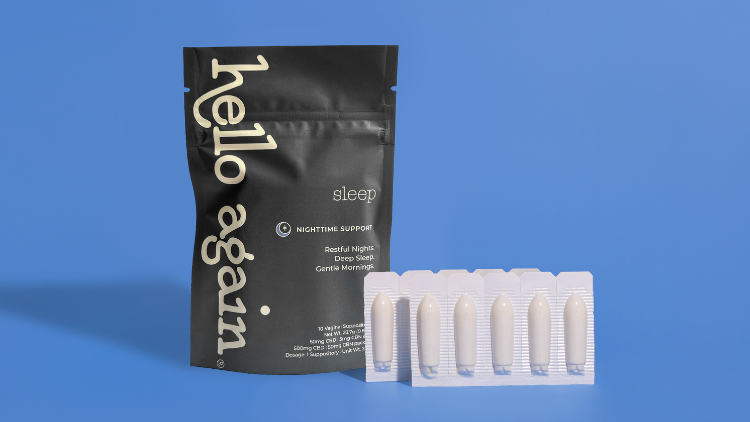
Vaginal suppositories bypass all of that. CBN and CBD are absorbed directly through mucosal tissue—rich in blood vessels and endocannabinoid receptors—into the systems they’re designed to support. Onset is faster. Absorption is more efficient. And the relief is both targeted and systemic: local tissue benefits alongside full-body support. You’re not waiting two hours for a gummy to kick in. The formula gets to work while you’re already winding down.
For sleep specifically, that distinction is everything. The best delivery method isn’t the most convenient one—it’s the one that gets the ingredients where they need to go.
What to Look for in a CBN Sleep Product
Not all CBN products are created equal—and with a market moving this fast, it’s worth knowing what to look for before you buy.
First, sourcing matters. CBN is produced naturally as cannabis ages, but in modern formulations, it’s typically extracted and concentrated from aged hemp or cannabis material. Look for brands that use clean, traceable sources and publish a Certificate of Analysis (CoA) confirming both CBN content and purity. If a brand isn’t showing you third-party test results, that’s a red flag.
Second, look at the full formula. CBN works best as part of a layered approach—not as a standalone ingredient. The most effective CBN sleep products pair it with complementary botanicals that target sleep from multiple angles. Valerian Root and Hops Extract support relaxation and sleep onset through GABA pathways. Lavender and Roman Chamomile ease anxiety, one of the most common barriers to sleep. CBD, alongside CBN, creates a complementary cannabinoid effect that neither delivers as well alone.
Third, consider the delivery method. As we covered, how you consume CBN determines how much of it your body actually absorbs. A beautifully formulated product taken in gummy form will always face the bioavailability ceiling that a suppository bypasses entirely.
Hello Again Sleep was formulated with all of this in mind—50mg CBD and 5mg CBN, paired with Valerian Root, Hops Extract, Lavender, and Roman Chamomile, delivered via suppository for maximum absorption. Every ingredient supports the next. It’s not a single-ingredient solution—it’s a layered approach designed for the real, multi-dimensional reasons sleep is hard.
How to Use CBN for Sleep
Using Hello Again Sleep is simple—but consistency is what makes the difference.
Insert the suppository 20–30 minutes before you want to be asleep. This gives the formula time to absorb and begin working before you’re fully settled in. Most users find that a consistent pre-bed routine—same time each night—produces the best results over time. Some people notice a difference the first night. For others, it builds over one to two weeks as cannabinoids accumulate in the system and the body adjusts. Either way, give it at least two weeks before concluding—and pay attention to the full picture: how easily you fall asleep, whether you stay asleep, and how you feel in the morning.
CBN isn’t a sleeping pill. It’s not about knocking you out—it’s about giving your body the conditions it needs to find rest on its own. The difference, when it works, is noticeable: falling asleep more easily, staying asleep longer, and waking up feeling like you actually slept.
Your CBN Questions, Answered
CBN is still new to many people—and we get questions. Here are the ones we hear most.
What is CBN, and how is it different from CBD?
CBN is a minor cannabinoid that forms as THC ages and oxidizes. Like CBD, it’s non-psychoactive—it won’t get you high. The difference lies in how they work: CBD interacts broadly across the endocannabinoid system, while CBN appears to act more selectively at CB1 receptors, which are associated with relaxation and sleep. The two are often used together for a complementary effect.
Does CBN actually help with sleep?
The anecdotal evidence is strong, and the mechanism is plausible, but clinical research is still catching up. We’re not going to oversell it—what we will say is that CBN is on the same trajectory CBD was a decade ago, and the science is accelerating. Hello Again pairs CBN with botanicals that have well-established track records in sleep support, so the formula works on multiple levels.
Is CBN safe?
CBN is generally considered safe and well-tolerated. It’s non-psychoactive and not known to produce significant side effects. As with any supplement, consult your healthcare provider if you’re pregnant, breastfeeding, or taking medications.
How long does it take to work?
When delivered via suppository, many users notice effects within 20–30 minutes. Greater improvements in sleep quality tend to build over one to two weeks of consistent use. Give it at least two weeks.
Can I use a suppository every night?
Yes—Hello Again Sleep is designed for nightly use. Consistency is key, and daily use allows the formula to build up in your system for more stable, sustained results over time.

Restful Nights. Deep Sleep. Gentle Mornings.
CBN for sleep is one of the most exciting areas of cannabinoid research right now—not because the science is settled, but because the direction it’s heading is clear. The mechanism is sound, the anecdotal evidence is compelling, and the research is accelerating. For women navigating hormonal sleep disruption, it’s one of the more promising tools available.
At Hello Again, we didn’t include CBN because it’s trending. We included it because it made sense—alongside CBD and a formula of botanicals known to support rest, delivered through the most effective method available. We’re not here to oversell it. We’re here to give you the full picture and let the formula speak for itself.
If you’ve tried everything and still can’t sleep, this might be the next thing to try. Restful nights, deep sleep, gentle mornings—that’s what Hello Again Sleep is designed for. And that’s what you deserve.
Key Takeaways
- CBN and Sleep: CBN is a non-psychoactive cannabinoid with a plausible, well-reasoned mechanism to support sleep—and it works differently from Melatonin or Magnesium.
- Delivery Method Matters: Delivery method determines how much of any sleep supplement your body actually absorbs, and suppositories bypass first-pass metabolism entirely, making them one of the most efficient ways to deliver CBN.
- Better Together: The most effective CBN sleep products don’t rely on one ingredient—they pair CBN with botanicals that support sleep from multiple angles.